Can a Dealer Legally Charge More Than MSRP? The Truth Behind the Price Tag
Think MSRP is the limit? Find out why dealers can charge more—and how you can stop overpaying.

Let’s imagine you’re at a dealership. You spot your dream car—it’s shiny, fast, red, and priced higher than the MSRP. Confused? You’re not alone. Many buyers assume the number on the window sticker is the maximum they’ll pay, since MSRP stands for “Manufacturer’s Suggested Retail Price.”
But that word suggests a murky world of dealer markups, market adjustments, and sometimes questionable sales tactics. So today, we’re diving into the nitty-gritty: Can a dealer charge more than MSRP—and what can you do about it?
Key Takeaways
- Negotiate Everything: MSRP isn’t a ceiling—always push back on markups.
- Know the Law: Dealers can legally charge more, but transparency is key.
- Shop Smart: Compare prices, skip add-ons, and be ready to walk away.
So let’s pull back the velvet curtain on the world of car pricing. Beyond the glossy paint and new car smell lies a complex dance between supply, demand, dealership strategy, and consumer behavior. We’ll explore how prices balloon beyond MSRP, why dealers defend these practices, and most importantly, what we, as car buyers, can do to stay informed, empowered, and in control at the negotiating table.
Car Buying Tip: Shopping for a new ride? Outsmart MSRP markups by requesting free quotes from multiple local dealers to compare real prices and score the best deal.
Table of Contents
- What is MSRP, and why does it matter?
- Why do dealers charge over MSRP?
- Is it legal for dealers to charge more than MRSP?
- Can you negotiate prices over MRSP?
- The role of add-ons and inflated pricing
- What you can do when a dealer charges too much
- What is additional dealer markup (ADM)?
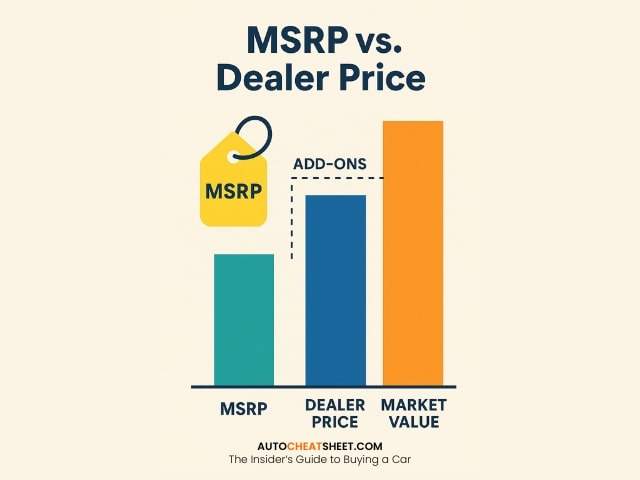
- MSRP vs. market value: What’s the difference?
- Are luxury cars priced over MSRP more often?
- Frequently asked questions
- Final thoughts
What Is MSRP and Why Does It Matter
MSRP stands for Manufacturer’s Suggested Retail Price. Think of it as a polite nudge from the car maker to the dealer saying, “Hey, this is what we think you should charge.” But here’s the twist: it’s just a suggestion. Dealers aren’t legally bound to follow it. It’s more of a starting point for negotiation rather than a firm ceiling or floor.
The manufacturer determines the MSRP based on production costs, market research, and profit margins. It’s printed on the window sticker—what’s lovingly referred to as the Monroney sticker—by federal law. Yet, what you see isn’t always what you get.

Why Do Dealers Charge Over MSRP?
When demand outpaces supply, prices go up. That’s economics 101. This applies to cars, too, especially when a hot new model drops or supply chains get disrupted. Here are some fundamental reasons why prices exceed MSRP:
- Limited supply: Think special editions or newly released models.
- High demand: Everyone and their cousin wants that new electric SUV.
- Market adjustments: Dealers add markups to reflect what people are willing to pay.
- Dealer add-ons: Fancy floor mats, paint protection, or mysterious “documentation fees.”
Dealers are businesses. They try to make a profit and sometimes do so by stretching the price beyond the sticker. This is just another of the many ways a dealership makes money.
Is It Legal for Dealers to Charge More Than MSRP?
Yes. It’s 100% legal in the U.S.
No federal law requires dealers to sell vehicles at or below the MSRP. As long as they disclose the price, and you willingly agree to it, the deal is fair game. Some states might require transparency on add-ons, but none say a dealer can’t price above MSRP.
That said, deceptive practices by dealerships—like hiding fees or false advertising—are illegal. So, if a dealer claims the MSRP is $50,000 but slaps on hidden fees later, that’s where the trouble starts.
Can You Negotiate Prices Over MSRP?
Absolutely. You should.
Just because a dealer asks for more than MSRP doesn’t mean you have to pay it. Negotiation is your best friend at a dealership. Many buyers have successfully talked dealers down, especially if:
- The car has been sitting on the lot for a while.
- You’re paying in cash or pre-approved financing.
- You’re flexible about color or trim.
A polite but firm negotiation can trim hundreds—or even thousands—off the final price even in a hot market.
- How to Buy a New Car Below Factory Invoice Price – True dealer cost and the factory invoice price are not the same… dealer cost can be much lower.
- Figure a Fair Profit New Car Offer – How to calculate a fair profit new car offer.
- How to Buy a New Car Online – Not sure where to start? Use my step-by-step guide on how to buy a new car online.
The Role of Add-Ons in Inflated Pricing
One of the sneakiest ways dealers hike prices above MSRP is through optional (but often pre-installed) add-ons:
- Nitrogen tire fill: Adds $200 to your bill. Regular air is… free.
- Paint protection: Sounds luxurious, but it’s often overpriced.
- Security etching: Sometimes useful, often overblown.
Smart Tip: Don’t Overpay for Add-Ons
Dealer-installed accessories often carry huge markups. Instead of paying full price, ask to see the service invoice or work order showing what the dealership paid. Then, negotiate closer to that cost—you’ll save big without skipping the extras.
| Add-On | Estimated Dealer Cost | Typical Asking Price | Potential Profit Margin |
|---|---|---|---|
| Fabric sealant | $45 | $475 | $430 |
| Paint sealant | $90 | $795 | $705 |
| Frame undercoat | $180 | $650 | $470 |
| Window etching | $65 | $375 | $310 |
| Alarm | $275 | $825 | $550 |
| Tire Nitrogen | $30 | $225 | $195 |
| Window tint | $40 | $295 | $255 |
| GPS tracker | $310 | $975 | $665 |
Bottom line: Don’t pay luxury prices for budget-cost products. If you still want the accessories, ensure you’re not lining the dealership’s pockets more than necessary.
What You Can Do When a Dealer Charges Too Much
If you’re faced with a dealer asking more than MSRP, you have options:
- Walk away: Sometimes the best decision is to walk away from the car deal.
- Shop around: Use free online car buying tools to compare free price quotes—other dealers in your area may offer better deals.
- Wait it out: Prices often fall once demand and popularity cools.
- Order directly: Some manufacturers allow custom factory orders at MSRP.
Remember, you’re the one holding the checkbook. Don’t let the pressure cloud your judgment.
Real-Time Bargain Hunting: Turn to Edmunds for instant access to the latest and greatest local deals, saving you time, money, and stress.
What Is Additional Dealer Markup (ADM)?
Additional Dealer Markup (ADM) is an extra charge a dealership adds to the vehicle’s Manufacturer’s Suggested Retail Price (MSRP). It’s not for parts or accessories—it’s purely an inflated cost meant to boost the dealership’s profit.
Unlike destination fees or government taxes, ADM is not required or standardized. It’s often labeled as “Market Adjustment,” “Dealer Profit,” or tacked on without explanation unless you ask.
How Dealers Justify ADM
Dealers might give a range of reasons to explain or defend ADM. Here’s what you’ll commonly hear:
- “It reflects current market demand.”
Popular cars, low inventory, or supply chain issues are used to justify higher prices. - “This model is in short supply.”
Limited availability lets the dealer treat it like a premium product. - “We’ve added value to the vehicle.”
Sometimes ADM is tied to minor customizations or dealer-installed accessories—whether you want them or not. - “Everyone is paying it right now.”
Dealers lean on trends and urgency to make ADM seem unavoidable. - “We need to stay competitive.”
Some dealers argue they must mark up vehicles to cover rising operating costs or compete in their market.
Important Note: ADM is negotiable. It’s not set in stone, and many buyers have successfully had it reduced—or removed entirely—by asking the right questions and being prepared to walk away.
MSRP vs Market Value: What’s the Difference?
This is a subtle but essential distinction.
- MSRP: Manufacturer’s Suggested Retail Price. Fixed by the car maker.
- Market Value: What people are willing to pay for the car. (popular or limited edition vehicles)
Market value can be thousands above MSRP during a supply crunch (like we saw in 2021-2022). In contrast, during overstock, market value can sink below MSRP.
Understanding this helps you navigate the negotiation waters better.
Are Luxury Cars Priced Over MSRP More Often?
Yes—and sometimes by a lot. High-end vehicles, especially limited editions or newly released models, are often sold with hefty premiums. Think Porsche 911 GT3, Tesla Plaid, or limited-run Ferraris.
If you’re in the luxury market, be prepared to either:
- Pay up.
- Or be very patient.
Frequently Asked Questions
Can a dealer legally sell above MSRP?
Yes. MSRP is just a suggestion, not a legal limit.
Why would anyone pay over MSRP?
High demand, limited supply, or emotional attachment can make people accept a higher price.
Is paying over MSRP ever worth it?
Sometimes, paying a bit extra now might save you more later if prices keep climbing for rare or hot models.
How do I know if a markup is fair?
Compare listings online. If a dealer’s price is wildly above others, you’ll know.
Can I refuse dealer add-ons?
Yes, if they haven’t been pre-installed. If they are, use them to negotiate a better price.
Will prices over MSRP come down?
Eventually, markets normalize. Unless it’s a collectible, waiting can pay off.
Conclusion: Dealer’s Charging Over MRSP
So, can a dealer charge more than MSRP? Yes, they can. Should you pay more than MSRP? That depends.
Ultimately, it comes down to awareness, timing, and negotiation. Dealers are within their rights to price vehicles above MSRP, but you’re also within your rights to push back—or walk away. It’s your money. Use it wisely.
About the author
 My name is Carlton Wolf, and I’ve been in the car business since 1994, both retail and wholesale. I created the Auto Cheat Sheet to better educate buyers about the deceptive sales practices many dealerships use nationwide. Please understand that not all car dealers are dishonest. However, you never know who you’ll be dealing with. I’m willing to share my knowledge and experience with anyone who listens. Keep in mind that I’m a car guy, not a writer.